If School Was More Flexible, What Could Your Junior
For most junior cyclists, the limiting factor isn’t talent; it’s time.
Training blocks get squeezed between school hours. Travel means missed class. Race opportunities come with trade-offs. And at a certain level, something has to give.
So it’s worth asking: What could your riders accomplish if their school schedule actually worked around their development—not against it?
The Reality Clubs Are Managing Today
If you’re coaching or supporting junior athletes, you’ve seen it firsthand:
Riders skipping key sessions to stay caught up academically
Athletes passing on race opportunities because of school conflicts
Performance dips during heavy academic periods
Burnout from trying to do everything at once
And as competition levels rise (national selections, international travel, UCI events) that friction only increases.
What Happens When That Constraint Is Removed
Some cyclists are starting to operate differently.
Instead of forcing training around a fixed school day, they’re switching to flexible academic models that move with their schedule.
The result? More consistent training. More race exposure. Less trade-off between performance and academics.
You can see that shift in athletes like:
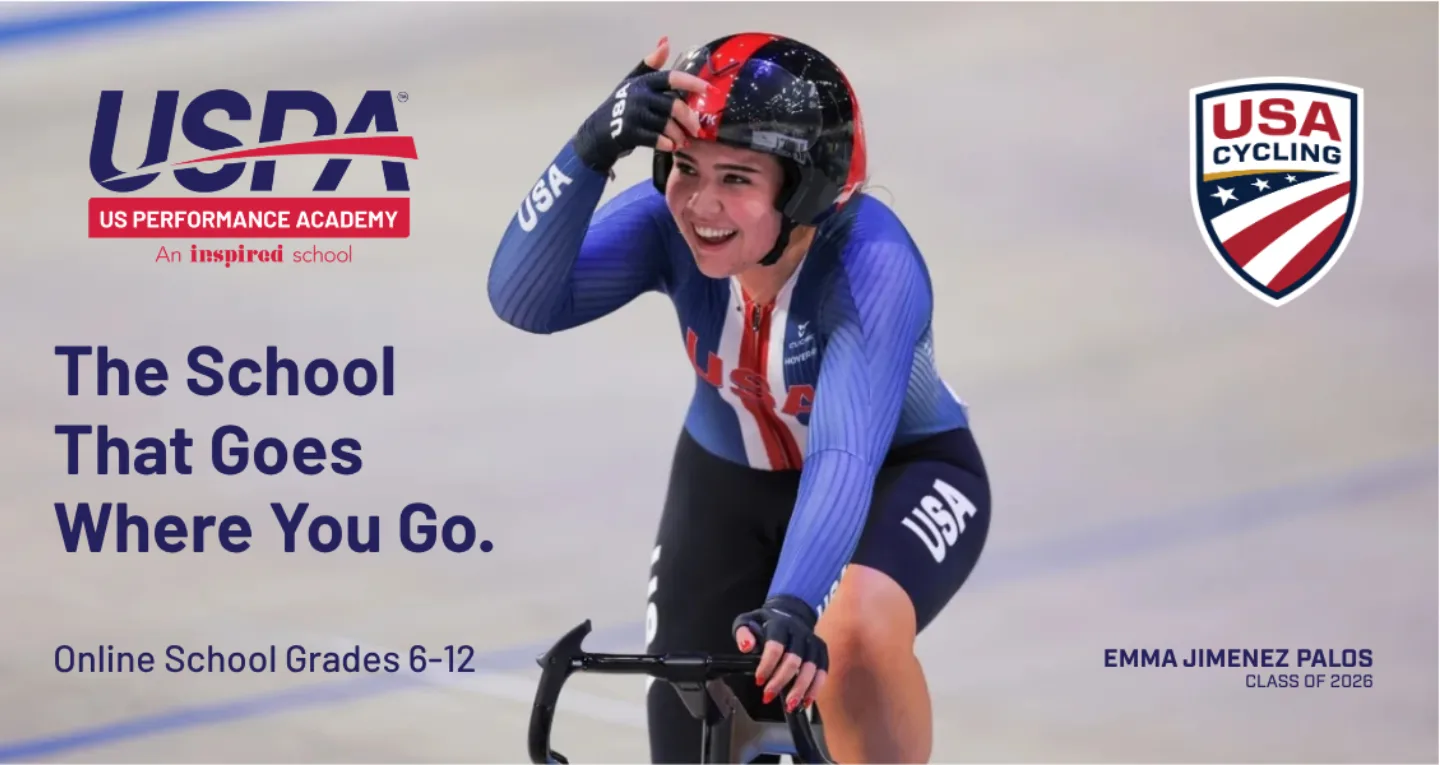
Emma Jimenez Palos, competing at the highest level internationally—winning a Scratch Race at the UCI Junior Track World Championships and earning gold at Pan American competition.
Luke Johnson, continuing to progress domestically with a 2nd place finish at USA Cycling Cyclocross National Championships.
These aren’t athletes doing less school—they’re athletes doing school differently.
From the Athlete’s Perspective
For riders balancing global competition, flexibility isn’t a “nice to have”—it’s the difference between participating and performing.
Kash Adamski, who competed internationally at the highest level, put it simply: “Kigali was incredible… I’m super grateful for the opportunity… none of it was possible without USPA. USPA has been extremely helpful in building my schedule around training for the biggest race of my career. Without a flexible schedule, I would not have been able to perform at the highest level.”
And on the long-term impact: “They allow me to travel the world and chase my dreams of becoming a pro all while getting an excellent education. Without USPA, I wouldn't be anywhere near the caliber of a racer or student that I am today.”
A Different Model (and Why It Matters for Clubs)
This shift isn’t just about individual athletes—it changes what’s possible for entire programs.
When school is no longer the constraint:
Athletes can commit fully to training cycles
Coaches can plan development more consistently
Riders can say yes to opportunities that accelerate progression
That’s where US Performance Academy (USPA) comes in.
USPA is a fully online school designed specifically for student-athletes, with:
Flexible scheduling built around training and travel
Personalized academic coaching
A structure that maintains rigor without fixed daily hours
It’s not about doing less—it’s about making high-level development sustainable.
What to Share With Your Junior Athletes
If you have riders in your club who are:
Traveling frequently for races
Pursuing national or international competition
Or starting to feel the pressure of balancing both
This is a model worth putting in front of them and their families.
USPA Virtual Open Houses offer a straightforward look at how it works—and whether it fits their path.
Encourage your junior athletes to explore USPA and see how it can support their goals—on the bike and beyond.
Please reach out to admissions@gouspa.org or manny.iloba@gouspa.org for any questions or support for your club.